
Case study · Employee advocacy
In 2021 part of ENGIE UK was about to become a new company, Bright, and would lose its existing social channels and followers in the move. ENGIE wanted up to 75 employees ready to carry the brand on their own LinkedIn profiles. We surveyed them first, then built LinkedIn and Twitter training around what they told us.
- 75 advocates targeted
- 34 staff surveyed before training
- 20 of them directors or senior
- 44% posted less than once a month
- Client ENGIE UK & Ireland
- Sector Energy and services
- Training LinkedIn, Twitter, employee advocacy
- When June 2021
- Audience Leaders and subject matter experts moving to Bright
- Format Live session, recorded for staff to revisit
What did ENGIE need?
In July 2021 part of ENGIE UK became Bright, a new business (now Equans). The brand would change, the company pages would start again from scratch, but the people would stay.
ENGIE’s brief was to create “a social media advocacy programme, starting with a group of up to 75 employees”, to ease the move to Bright on social media and keep employees engaged. Training was the first step.
- Business objective: carry ENGIE’s audience across to Bright without starting from zero.
- Training objective: give up to 75 key employees the skills and confidence to share and engage with company content on LinkedIn, including LinkedIn’s My Company tab.
What was the insight?
Our pre-training survey of 34 staff showed this wasn’t a skills gap. Everyone used LinkedIn and 91% rated themselves intermediate or advanced. Yet 44% posted less than once a month.
The barriers were permission and ideas. The top answers were “not sure on the rules around social media use at ENGIE” (42%) and “not sure what to post” (39%). So the training had to make the rules clear and hand people content they could use straight away.
What did the training cover?
- Starting from their answers. We opened by playing back the survey results, so the group saw where they stood.
- LinkedIn 101 and profile polish. Setting up profiles to reflect the new business, and what good looks like.
- Content planning. What to share, how to use the My Company tab, and how to write posts people engage with.
- Building a network. Creator mode, growing connections and finding the right conversations.
- Measuring success and what can go wrong. The metrics that matter and the pitfalls to avoid, plus Twitter in brief.
- Five things to do differently tomorrow. Every session ended with clear actions, and the recording stayed available for staff.
Will Ockenden and Erin Jones delivered the training, with ENGIE’s Niel Scott opening on the advocacy programme.
What did it achieve?
Results by stage of the AMEC evaluation framework, with the source for each figure.
| Stage | Measure | Result | Source |
|---|---|---|---|
| Inputs | Pre-training survey responses | 34 | SurveyMonkey, May 2021 |
| Inputs | Staff posting less than once a month | 44% | SurveyMonkey, May 2021 |
| Outputs | Bespoke training course | 74-slide deck, delivered live and recorded | Training materials, June 2021 |
| Outputs | Advocates targeted | Up to 75 employees | ENGIE brief, May 2021 |
| Impact | Ongoing training relationship | Staff training in 2019 and 2021, then paid social training for Equans in 2024 | Training records |
What did ENGIE get from it?
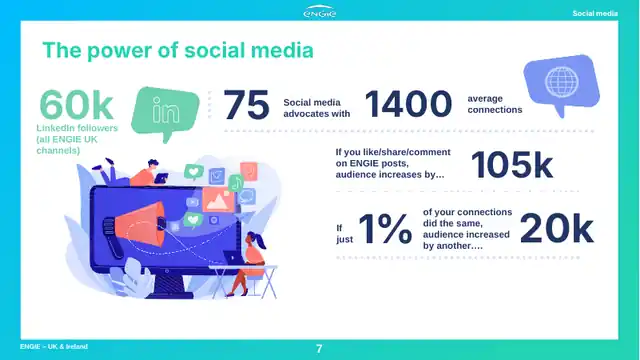
A group of senior people who knew the rules, knew what to post and had a plan to keep ENGIE’s audience engaged through the switch to Bright. ENGIE’s own model showed why it mattered: 75 advocates with an average of 1,400 connections each could take its potential LinkedIn reach from 60,000 to 105,000.
The relationship carried on through the change of name, and we’ve since built paid social training for Equans.
What did we learn?
- Clear rules unlock posting. The biggest barrier wasn’t ability, it was uncertainty about what was allowed. A simple social media policy belongs alongside the training.
- Survey first. Playing back the group’s own answers made the session feel built for them.
- What we would do differently. Hold the three-month review we proposed, and track advocate shares and My Company activity from day one, so the results are as clear as the brief.
Planning an employee advocacy programme? Talk to us about LinkedIn training for your team.
