
Content marketing training
Content marketing training for teams who are already busy
Most teams do not have a content problem, they have a volume problem. Too much being made, too little of it working, and nobody quite able to say which posts earned anything. This day is about producing less and getting more from it.
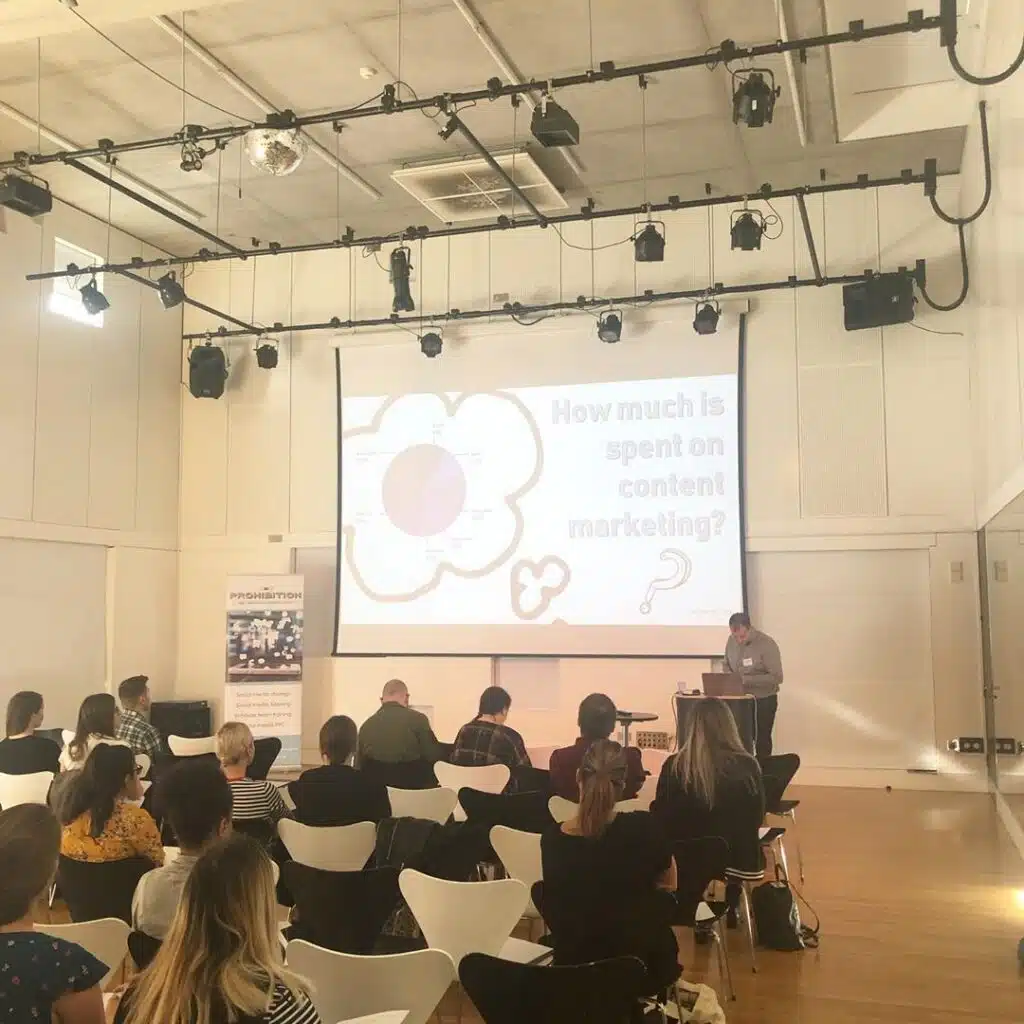
What the day covers
Built around your brief and your own content. This is the usual shape.
Deciding what to make
Working back from a business question rather than forward from a content calendar. The bit that saves the most time.
Formats that suit your resources
An honest look at what a team your size can sustain, and permission to stop doing the things that never worked.
Writing that gets read
Structure, openings, and answering the question early. Also the difference between writing for a search engine and writing for a person, which is smaller than people think.
Repurposing properly
One piece of work, several outputs, without the flat copy and paste versions everybody scrolls past.
Distribution and earned attention
We are a PR agency, so this is our natural ground. Getting content in front of people who were not looking for it.
Measuring what happened
A reporting view that answers a business question, and what to do when the honest answer is that a channel is not working.
Why most content marketing training misses
The standard course teaches a framework, a persona template and a calendar. Teams come back full of enthusiasm, run it for six weeks, then quietly stop because nobody had the time and no one could prove it was worth it.
Producing more content is the wrong answer to almost every content problem.
So we spend the morning on the decision rather than the process, and we are prepared to tell a client that half of what they publish should be scrapped. That conversation is uncomfortable and it is usually the most valuable part of the day.
There is a second thing that has changed. A growing share of people never reach the page, because an AI assistant summarises the answer for them. That does not make content pointless, but it does change what a good page looks like. Answer early, be specific, and be the source worth citing.
Who it is for
- Marketing teams producing plenty and converting little.
- Communications teams asked to add content to an already full job.
- Small teams choosing between an agency, a freelancer and doing it in-house.
- Anyone who has inherited a content calendar nobody can explain.
What your team leaves with
- A content plan for the next quarter, written in the session.
- A stop list, which matters more than the start list.
- Templates for the two or three formats you will actually repeat.
- A reporting view that answers a business question.
- The slides, a workbook and a follow up a month later.
Cost and format
All prices exclude VAT. Delivered at your offices, at our Leeds studio, or remotely, at the same cost either way.
| Format | Length | People | Cost |
|---|---|---|---|
| Half day | Three hours | Up to six | £1,200 |
| Full day | Six hours with breaks | Up to six | £1,800 |
| Additional attendees | Either format | Each beyond six | £250 |
| Ongoing programme | Several sessions | Any size | Quoted after a scoping call |
Full day is the common choice here, because the planning work in the afternoon is where the day pays for itself.
Who runs the day

I am Chris Norton and I run most of these sessions myself. I founded Prohibition, the PR, social and content agency behind this site, and I have been running marketing training since 2009. I have worked in public relations for more than twenty years, which is long enough to have watched content marketing get invented, oversold, and then quietly become the job.
I co-authored Share This Too, the social media handbook published by the Chartered Institute of Public Relations, and I have been a CIPR member since I was a student. I write Norton Notes and I co-host the Embracing Marketing Mistakes podcast with my co-director Will Ockenden, which is a long run of conversations with marketers about work that did not go to plan.
None of that is on this page to be impressive. It is here because most course pages will not tell you who is standing at the front, and you are entitled to know before you book a day of your team’s time.
The agenda, hour by hour
This is the full day. The half day is the morning, plus whichever afternoon block matters most to you. We send a short brief form first and rebuild the running order around your answers, so treat the timings as the shape rather than a script.
09:30, what you are actually for
We start with the business question, not the calendar. Every team in the room writes down the one thing content is supposed to change this year. It is harder than it sounds and it reframes the rest of the day.
10:15, an honest audit of what you publish now
We go through your last three months of output on the screen. What earned something, what did not, and what nobody can remember commissioning. This is where the stop list starts.
11:15, formats a team your size can sustain
Matching format to the resources you genuinely have, rather than the ones a case study assumes. Two formats done properly beat six done occasionally.
12:00, writing that gets read
Openings, structure, and answering the question early. We rewrite one of your own pieces together, live, which is usually the moment the room goes quiet.
13:30, search, and the AI answer problem
How writing for a search engine differs from writing for a person, which is less than people think, and what changes when an assistant summarises your page instead of sending someone to it. Answer early, be specific, be the source worth citing.
14:15, repurposing without the copy and paste
One piece of work, several genuine outputs. We build the repurposing chain for a real piece you already have, so you leave with the workflow rather than the theory.
15:00, distribution and earned attention
We are a PR agency, so this is our natural ground. Getting content in front of people who were not searching for it, using journalists, partners, communities and paid support where it earns its place.
15:45, measurement you can defend
A reporting view that answers the business question from 09:30, and what to say when the honest answer is that a channel is not working.
16:15, the plan
Your next quarter, written in the room, with owners and dates against it. Nobody leaves with homework and good intentions.
What content work has produced for our clients
We are a working agency first, so the examples in the room are ours. These are three we can put numbers against.
Astonish. 115 pieces of coverage in six months, 90 per cent of which carried a backlink. That is the earned distribution half of this course, run at scale for a cleaning brand.
Martin House Children’s Hospice. The Build produced 219 placements and 161.4 million reach, and won the Charity and Not for Profit Award at the PRCA DARE Awards in 2026.
Freeths. A LinkedIn Live programme for the law firm drew 1,100 attendees and around 950 leads from a single sequence, which is the repurposing and distribution session in practice.
We have also run training programmes for ENGIE, Huthwaite International and Keepmoat Homes.

|

|

|
Who we have trained
We have delivered training and campaigns for the NHS, Yorkshire Water, Transport for the North, Savills, Skipton Building Society, Interflora, Watches of Switzerland, Sealy, Emerald Publishing, Huthwaite International, ENGIE, CEWE Photoworld, Lloyds Pharmacy, WWF, Alzheimer’s Society and Terrence Higgins Trust, alongside universities, local authorities and B2B manufacturers across the UK.
What our clients say
Prohibition holds a rating of 4.9 out of 5 from 19 reviews on Clutch.
“We were impressed by their depth of knowledge in a rapidly changing environment.”
Kian Scott-Loach, Head of Digital, Terrence Higgins Trust, February 2026
“Prohibition has put a lot of care and hard work into the project.”
Maria Kirby, Head of Digital, commercial law firm, July 2025
“They’re a bunch of friendly people who feel like a natural extension of the marketing team.”
David Sharples, Communications Manager, Black Sheep Brewery, January 2025
Dates, and why we do not run public courses
We do not publish a schedule of open courses, and that is deliberate. A public course has to be written for the average person in the room, which means a third of your team is bored and a third is lost. Every session we run is private to one organisation.
In practice we can usually be with you within three weeks of agreeing a brief, and often sooner for a half day. We deliver at your offices, at our studio in Leeds, or remotely, and the cost is the same either way. Most of our work is in Leeds, Manchester and London, but we travel and we do not charge extra for it.
What it works out at per person
A full day at £1,800 for six people is £300 each, and every extra attendee is £250. Public one day courses in the UK run from roughly £295 to £1,495 per person, so once you are sending three or more people, a private day is usually the cheaper option as well as the more useful one. You also keep the recording, the workbook and a plan built on your own content rather than a worked example about a fictional brand.
Questions we get asked
Will you work on our own content?
Yes. We ask for recent examples before the session and we go through them properly, including the ones that did not work.
Do you cover video?
At a level, yes. If video is the main need, our video production training is the better day and it is one of our most booked.
Is this about SEO?
Partly. There is a session on writing for search and for AI answers. If search is the main driver, take SEO and AI search training instead.
We have no budget for tools. Does that matter?
No. Everything we teach can be done with what you already have. We will flag where a paid tool genuinely saves time and where it does not.
How many people can attend?
Six is the sweet spot and twelve is the ceiling for hands on work. For bigger groups we usually run the same day twice.
Can you invoice against a purchase order?
Yes. We are used to public sector and large corporate procurement, and we hold professional indemnity and public liability insurance.
How much does content marketing training cost in the UK?
A half day for up to six people is £1,200 and a full day is £1,800, both excluding VAT, with additional attendees at £250 each. That works out at £300 a head for a full day with six people. Public one day courses in the UK typically run from £295 to £1,495 per person.
Can you run content marketing training in-house for our team?
Yes, and it is the only way we run it. Every session is private to one organisation and built around your own content and your own brief. We deliver at your offices, at our Leeds studio, or remotely, at the same cost either way.
How long is the content marketing course?
Three hours for the half day and six hours with breaks for the full day. Most teams take the full day, because the planning work in the afternoon is where the day pays for itself and it is the part you cannot rush.
Do you run content marketing training in London, Manchester or Leeds?
Yes. We are based in Leeds and most of our work is in Leeds, Manchester and London, but we deliver across the UK and we do not charge travel on top. Remote sessions cost exactly the same as in person.
Do we get a certificate?
Yes, every attendee gets a certificate of attendance. It is not an accredited qualification.
What qualifications does the trainer have?
Chris Norton runs most sessions. He founded Prohibition, has worked in public relations for more than twenty years, co-authored the CIPR social media handbook Share This Too, and has been a CIPR member since he was a student.
Is content marketing training worth it for a small team?
It is usually worth more to a small team than a large one, because the biggest gain is deciding what to stop making. Teams of two or three leave with a shorter list and a defensible reason for it, which is the whole point.
Do you cover AI writing tools?
Yes, honestly rather than evangelically. We cover where assistants genuinely save time in research and repurposing, where they produce copy that reads as generated, and how AI answer engines choose which sources to cite.
Can you train people who are completely new to content?
Yes, and we would rather do that than mix beginners with experienced managers in one room. If your team spans both, we usually split the day into two shorter sessions so nobody is bored and nobody is lost.
Do you offer online content marketing training?
Yes. The remote version runs to the same agenda, in shorter blocks, and costs the same as the in person day. It works well for distributed teams, although the live rewriting session is a little easier in a room.
How soon can you deliver the training?
Usually within three weeks of agreeing a brief, and often sooner for a half day. We send a short brief form first and ask for recent examples of your content so the session is built on your material rather than ours.
What happens after the training day?
You keep the slides, the workbook, the templates and the plan written in the room. We also answer follow up questions by email for a month afterwards, which most teams use once they hit the first awkward decision.
Where this sits in the wider programme
Content rarely stands alone. Teams focused on discoverability pair this with SEO and AI search training. Teams making a lot of video add video production training. Teams who need to prove the effect add measurement training, and teams chasing earned coverage add public relations training.
You can also browse all our training courses, training by sector, training by platform or formats, levels and prices.
Brands we have trained and worked with
Training and campaigns delivered for the NHS, universities, local authorities, charities and B2B manufacturers, alongside the brands below.











PRCA DARE Awards 2026 winners. The Charity and Not for Profit Award for The Build, our campaign for Martin House Children’s Hospice, which produced 219 placements and a reach of 161.4 million. Prohibition has won more than 45 industry awards.
Where does AI fit in content marketing?
It changes the drafting economics and nothing about whether the idea is any good. For documents, decks and reports inside Microsoft 365 see Microsoft Copilot training. For social first content see AI for social media content training.
Tell us who needs training
A trainer replies inside one working day with cost, dates and an honest view on fit.
