
How to run social media training: twelve ideas and a ready-made course plan
This social media training guide is for the person who has been asked to train the team, not the person buying a course. We have run this training since 2009. It gives you five objectives, twelve timed exercises and a half day running order for six to sixteen people, built so the team leaves doing something differently on Monday.
Everything here is free to use inside your own organisation. If you would rather somebody else ran it, that is at the bottom of the page.
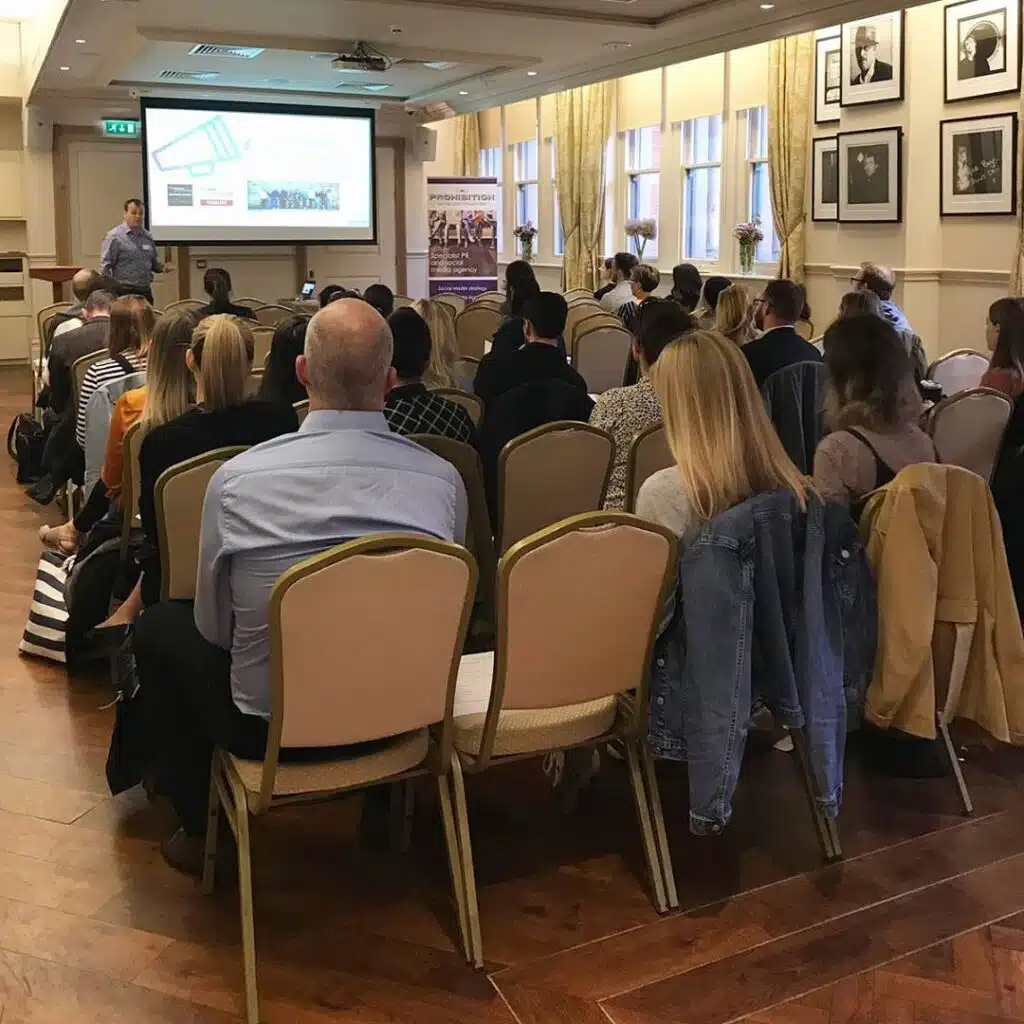
Write the objectives before you write a single slide
Most internal social media training fails at this point rather than on the day. Somebody books a room, builds forty slides about the platforms and nobody can say afterwards what was supposed to change. Decide which of these five outcomes you are actually buying, and write the one you pick at the top of the running order.
Reduce risk
Fewer people posting things that create a legal, regulatory or reputational problem. Measured by incidents, and by how quickly the ones that happen get escalated.
Lift employee reach
More staff sharing company content, in their own words, without being nagged. Measured by the number of active sharers rather than total shares.
Raise baseline competence
Everybody reaches the same minimum standard on the platforms your organisation actually uses. Measured by a short assessment before and after.
Fix accountability
One named person owns measurement afterwards. Without this the training has no owner and no follow through, and it will not survive contact with the day job.
Move a business number
Applications, enquiries, attendance, donations, applications for roles. Pick one number the leadership already watches and tie the session to it.
The test for all five
If you cannot describe what somebody will do differently on Monday, the objective is not written yet. Rewrite it as a behaviour, not as knowledge.
Four audiences, four different sessions
Almost every guide on this subject writes about training “employees” as though they are one group. They are not, and putting them in one room is the most common reason people leave saying it was not relevant to them.
Everybody, sixty minutes
The policy, what to do if something goes wrong, and permission to share company content. Keep it short, make it about them rather than about the brand, and do not teach the platforms. This session exists to stop problems and to unlock advocacy.
Client facing and sales teams, half day
Profiles, listening, targeted outreach and following up properly. This is the group where training pays back fastest, because they already have commercial targets and social media is a route to them.
The social or comms team, full day
Strategy, content planning, measurement and governance. This group needs depth rather than breadth, and they will disengage inside ten minutes if you start with what a hashtag is.
Executives and spokespeople, ninety minutes
Personal profile, tone, what to do when a post goes badly and how to handle a pile on. Run this separately and run it privately. Senior people will not ask honest questions in front of their teams.
Three shorter sessions for the right groups will always beat one long session for everybody.
Twelve social media training ideas that change behaviour
These are exercises rather than topics. Each one has a rough timing and a materials note, so you can drop it straight into any training session. They are the ones that have consistently worked for us in rooms of five to fifty people.
The screenshot audit, twenty minutes
Put six of your own recent posts on screen with the numbers hidden. Ask the room to rank them by performance. Then reveal the actual figures. The gap between what people assume works and what does work is the whole argument for the rest of the day, and it lands better than any slide.
Rewrite a real post, twenty five minutes
Take one genuinely mediocre post from your own channels. In pairs, rewrite it for a named audience. Read three out loud. Never use a competitor’s post for this, because the defensiveness disappears when the flawed example is yours.
The policy in plain English, thirty minutes
Hand out your actual policy. Ask each table to translate one clause into a sentence a new starter would understand. You will find at least one clause nobody can decode, which tells you the policy needs rewriting as much as the team needs training.
Crisis role play, thirty minutes
Give the room a live scenario. A customer complaint escalating, a member of staff posting something ill advised, a journalist in the replies. Fifteen minutes to draft a response, fifteen to pull it apart. This is the exercise people remember a year later.
Profile surgery, twenty minutes
Everybody opens their own LinkedIn profile and rewrites their headline while you walk the room. Do it in the session rather than as homework, because homework does not happen. Ten profiles improved is a tangible outcome from a single half hour.
The five minute listening exercise, fifteen minutes
Search your own brand name, your competitor and your sector term. Read what is actually being said out loud. Most teams have never done this deliberately and it usually changes what they think their content should be about.
Content pillars on paper, thirty minutes
Three to five pillars, written on flipchart, argued over. Then test every recent post against them. Anything that fits no pillar either needs a new pillar or should not have been published.
The AI disclosure debate, twenty minutes
Show two versions of a post, one drafted with a generative tool and lightly edited, one written from scratch. Ask which is which and whether it matters. Then agree, in the room, what your disclosure rule is. Almost no organisation has written this down and everybody’s staff are already using the tools.
Kill the vanity metric, fifteen minutes
List every number the team currently reports. Cross out anything that would not change a decision. Teams routinely go from fourteen metrics to four, and the reporting gets read for the first time.
The competitor teardown, twenty five minutes
Pick one competitor doing visibly better. In groups, work out exactly what they are doing that you are not. Ban the phrase “bigger budget”, which forces the room onto things that are actually within reach.
Two weeks in the diary, twenty minutes
Before anybody leaves, fill a fortnight of the content calendar with named owners. Training that ends without something in the diary reverts within a week, and this single step is the difference between a good day and a day that mattered.
The one thing round, ten minutes
Everybody says one thing they will do differently, out loud, and you write it down. Send the list round afterwards. Public commitment in front of colleagues outperforms every feedback form ever printed.
A half day curriculum, minute by minute
This is the running order we use for a mixed in-house group of six to sixteen people. Copy it, change it, use it. You need a screen, your own analytics open, flipchart paper and printed copies of your social media policy.
| Time | Session | What happens |
|---|---|---|
| 0:00 to 0:15 | Why we are here | The objective, written on the wall. One recent example of social media going right and one of it going wrong, both from your own sector. |
| 0:15 to 0:35 | The screenshot audit | Exercise one. Six posts, ranked blind, then revealed. This sets up everything that follows. |
| 0:35 to 1:00 | Audience and listening | Who you are actually reaching against who you think you are. Exercise six runs inside this block. |
| 1:00 to 1:15 | Break | A real break. People check their phones and come back sharper. |
| 1:15 to 1:45 | Content pillars | Exercise seven. Pillars on flipchart, then tested against recent output. |
| 1:45 to 2:10 | Rewriting in practice | Exercise two, in pairs, read aloud. Add exercise five here if the group is client facing. |
| 2:10 to 2:40 | Policy, risk and AI | Exercises three and eight. The plain English translation, then the disclosure rule agreed in the room. |
| 2:40 to 3:05 | Crisis role play | Exercise four. The scenario should be plausible for your organisation and slightly uncomfortable. |
| 3:05 to 3:25 | Measurement | Exercise nine, then agree the four numbers you will actually report and who owns them. |
| 3:25 to 3:30 | Commitments | Exercises eleven and twelve. A fortnight in the diary and one commitment each, written down. |
For a full day, keep the same spine and widen it. Add a strategy block after the audit, give the crisis role play a full hour with two scenarios, and put a proper planning session at the end so people leave with a quarter mapped rather than a fortnight.
What goes in the training manual
If you are writing a manual for people to keep, this is the section list that actually gets used. Anything longer than about fifteen pages will sit in a drawer.
- The one page summary. What we are trying to achieve and who owns it.
- The policy, in plain English, with the legal wording as an appendix rather than the opening.
- Who can say what, on which account, and who approves it.
- Escalation. Names, phone numbers and the first three things to do when something goes wrong.
- Tone of voice, with three good examples and three bad ones from your own channels.
- The content pillars, with a worked example of a post under each.
- Disclosure rules, including the use of generative tools.
- The four numbers you report and where they come from.
- A single page checklist for before you publish.
The UK specifics almost every guide misses
Nearly all the advice on this subject online is written for a United States audience, and it skips things that matter here. Your policy should reference UK GDPR when staff handle customer data through direct messages. Employees posting about their employer fall under Advertising Standards Authority disclosure rules when there is an incentive involved. Dismissal for a social media post has to survive an employment tribunal, so the policy needs to be communicated, dated and acknowledged rather than simply published on an intranet. If your organisation is in a regulated sector, the sector rules sit above all of this and should be in the manual by name.
How to tell whether it worked
- Ask three questions before and after. Confidence, knowledge of the policy, and whether they know who to escalate to.
- Count the actions in the diary at the end of the session, then count how many happened at thirty days.
- Track active sharers rather than total shares. Ten people posting once beats one person posting ten times.
- Log incidents and escalation speed for six months either side.
- Ask the named owner for a one page report at ninety days. If nobody can produce it, the accountability objective failed.
Mistakes we see most often
- Training everybody together, so nothing is relevant to anybody.
- Teaching platforms instead of judgement. Platforms change, judgement does not.
- No exercises. A presentation is not training.
- Using competitor examples instead of your own, which lets everybody off the hook.
- Finishing without anything in the calendar.
- Running it once. Behaviour change needs a follow up session at ninety days.
- Nobody owning it afterwards, which is the single biggest predictor of failure.
When to run it yourself and when to bring somebody in
Being honest about this matters more than winning the enquiry. Run it yourself when the objective is policy and risk, when the group is large and the content is mostly your own rules, or when you have somebody internally who is respected and can hold a room. That covers a good proportion of internal social media training and you do not need to pay anybody for it.
Bring somebody in when the room includes people more senior than the trainer, when the team has heard the internal voice too many times, when you need current practice rather than a summary of what your organisation already believes, or when the session has to produce a strategy rather than raise awareness. An outsider can also say the uncomfortable thing that an employee cannot.
If that is you
We run private sessions for in-house teams at your offices anywhere in the UK, at our Leeds studio, or live online. Half day £1,200, full day £1,800, up to six people, with additional attendees at £250 each, all excluding VAT. Everything is built on your own channels rather than a stock deck.
I am Chris Norton. I founded Prohibition, the PR, social and content agency behind this site, I have worked in public relations for more than twenty years, and I have been running training since 2009. I co-authored Share This Too, the social media handbook published by the Chartered Institute of Public Relations.
Frequently asked questions
How long should social media training be?
Sixty minutes for an all staff session on policy and advocacy. Half a day for a working team that needs to change how it operates. A full day when the output has to be a strategy or a plan. Anything beyond a day in one sitting loses the room.
What are the objectives of social media training?
Usually one of five. Reducing risk, lifting employee advocacy, raising baseline competence, establishing accountability for measurement, or moving a specific business number. Pick one as primary. Sessions that try to do all five achieve none.
Can I use this curriculum in my own organisation?
Yes, freely, including in paid internal sessions. We would appreciate a credit if you republish it externally, but there is no restriction on using it internally.
How many people should be in the room?
Six to sixteen for a working session with exercises. Above about twenty the exercises break down and it becomes a presentation instead. All staff briefings can be much larger because they are not exercise led.
Should training cover artificial intelligence tools?
Yes, and almost no existing training does. Your staff are already drafting with generative tools. The useful content is not a tools demonstration but a disclosure rule, an approval route and a clear line on what must not be put into a public model.
How often should we repeat it?
An annual refresher for everybody, a ninety day follow up after any substantial session, and a short induction module for new starters. Platforms change quickly enough that a two year gap leaves the content wrong rather than merely stale.
What do we need in the room?
A screen, your own analytics logged in, flipchart paper and pens, printed copies of your policy, and a genuine break. Wifi that works for everybody matters more than people expect, because half the exercises need phones.
How do we train a hybrid or multi site team?
Run it live online rather than trying to include remote people in a physical room, or cap the remote group at eight if you must go hybrid. Remote attendees in a room based session almost always end up as spectators.
What is the 3-3-3 rule for social media?
The 3-3-3 rule usually means three types of content (educational, inspiring and entertaining) shared through three kinds of channel: owned, earned and paid. Another common version is three key messages, aimed at three audience groups, through three main channels. Either way it is a rule of thumb. In a training session it makes a decent warm-up, but the content pillars exercise above is where the team actually agrees what to post.
What is the 5-3-1 rule on social media?
The 5-3-1 rule is an engagement habit, usually done daily or each time you post: like five posts in your field, comment on three and follow one new account. A comment only helps if it says something a person actually thought, so a string of emojis doesn’t count. It suits the client facing and sales session better than the all staff one.
Who we are, and who we have trained
We have been running social media training since 2009. Training and campaigns delivered for the NHS, universities, local authorities, charities and B2B manufacturers, alongside the brands below.











PRCA DARE Awards 2026 winners. The Charity and Not for Profit Award for The Build, our campaign for Martin House Children’s Hospice, which produced 219 placements and a reach of 161.4 million. Prohibition has won more than 45 industry awards.
Should your team be using AI for these posts?
For ideation and second drafts, often yes. For anything a reader is meant to believe, only with the facts checked. The difference between a post that lands and one that reads as machine written is a brand voice reference and a short list of tells, both of which we build in AI for social media content training.
Would you rather somebody else ran it?
Private in-house sessions built on your own channels. Half day £1,200, full day £1,800, up to six people, excluding VAT.
Last reviewed October 2026, with generative AI disclosure guidance and UK specific policy notes.
Part of our strategy and measurement training, alongside every social media course we run and our training formats. Last reviewed August 2026.
